

Imagine life without fresh, clean water. That is one of the risks looming over the GCC nations. They are among the largest consumers of water with some of the lowest natural water reserves in the world.

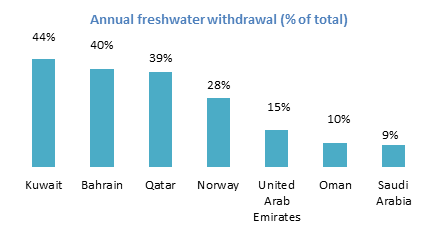
There is a huge gap between Norway (76,117 cu.mt.) and GCC countries in terms of internal water sources. Given the geography of the region, these numbers are expected to be lower, but the consumption of water is much higher and conservation efforts much lower than the rest of the world. Saudi Arabia is better off than most GCC countries, while Kuwait is completely dependent for freshwater.
Water Footprint
The Water Footprint Network measures the water footprint measures the amount of water used/ and polluted to produce each of the goods and services we use. The water footprint has three components: green, blue and grey.
 Green water footprint is water from precipitation that is stored in the root zone of the soil and evaporated, transpired or incorporated by plants. It is particularly relevant for agricultural, horticultural and forestry products.
 Blue water footprint is water that has been sourced from surface or groundwater resources and is either evaporated, incorporated into a product or taken from one body of water and returned to another, or returned at a different time. Irrigated agriculture, industry and domestic water use can each have a blue water footprint.
 Grey water footprint is the amount of fresh water required to assimilate pollutants to meet specific water quality standards. The grey water footprint considers point-source pollution discharged to a freshwater resource directly through a pipe or indirectly through runoff or leaching from the soil, impervious surfaces, or other diffuse sources.
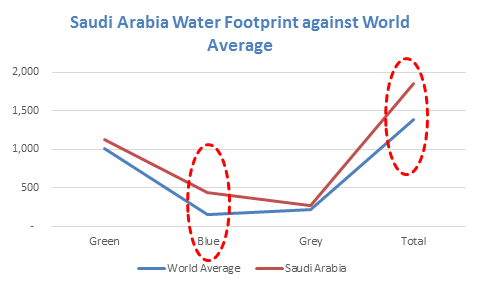
Of the GCC, countries where data is available, it can be clearly seen that water footprint is higher for GCC countries than the world average. For Saudi Arabia, the gap is widest for Blue water i.e. ground water sources.
Stress on groundwater resources in Saudi Arabia in past years has led to the reduction of the area under cereal cultivation from about 1.12 million ha in1990-92 to about 0.32 million ha in 2008- 2010. The country has adopted a decree in 2008 that seeks to gradually phase out all water-intensive agricultural crops by 2016 (FAO, 2012).
Saudi Arabia
Since the first oil boom in the 1970s, Saudi policy makers in the agriculture sector ignored the reality that the country land is mainly arid, located on the desert belt of the earth where desertification, scarcity of underground water resources, and the lack of perennial rivers or permanent running water are vital issues to be addressed and respected in any design or process of policy making in the agriculture sector.
In fact, in their aggressive quest to attain self-sufficiency in some grain items such as wheat (for human consumption) and barley (for livestock fodder), policy makers succeeded in reaching some of their goals for few years. However, they failed to succeed in sustaining growth and continuity of achievements in the long run, due to the severe depletion of nonrenewable fresh fossil water.
Now, the country has prompted the development of extensive seawater desalination facilities in order to face the rising demand on water for urban uses. Although some restrictions are now imposed on use of water from aquifers for irrigating some field crops including grains, no restrictions are imposed on planting more palm trees, which is considered by experts as one of the heaviest water-consuming items.
The virtual water concept is appealing for water scare countries. It affords them the opportunity to attain food security by importing water-intensive products instead of using internal water resources to produce low-value water products.
UAE
A report from the Emirates Industrial Bank in 2005 said that the UAE had the highest per capita consumption of water in the world. Additionally, for the past thirty years the water table of this region has dropped about one meter per year.
At this current rate, the UAE will deplete its natural freshwater resources in about fifty years. Even with a large amount of desalination plants to reduce water deficiency, the UAE needs to adjust its water use habits before its energy consumption doubles in 2020.
Desalination
GCC countries have become heavily dependent on seawater desalination to meet their municipal and industrial water demand. This has been made possible by the region’s abundant and subsidized energy resources necessary for energy intensive desalination plant operations.
But they are in overuse in the GCC. Seventy percent (70%) of desalination plants in the world are located here, found mostly in Saudi Arabia, the United Arab Emirates, Kuwait, and Bahrain.
GCC has realized this as a potential threat but is yet to seriously look beyond desalination. Unfortunately, due to its geography, it is left with few options but to depend on the world for its water needs. Areas where it could make a difference could be water conservation and water recycling.