

Oil and Gas exporting countries of the GCC have realized the importance of transition towards renewable energy. With all of them almost 100% dependent on fossil fuel energy consumption, they are expected to have only enough for domestic consumption by 2030 (World Bank). All of them therefore are now ‘Catching the Sun’ quite literally.
For the last several years, GCC countries charted a critical role for themselves in the shift to renewable energy. They have emerged as investors in major solar and wind projects worldwide and are also adopting innovative and increasingly cost-competitive technologies in their own domestic markets. The Solar GCC Alliance between them is to encourage each of its affiliate countries to pursue independent solar development, while simultaneously providing an infrastructure for international collaboration.
With the advent of lowest solar prices in the world, Gulf countries are set to capitalize on their promising solar resources for power generation and water desalination. As the present market analysis finds, the GCC region can cut its annual water use by 16 per cent, save 400 million barrels of oil, create close to 210,000 jobs and reduce its per capita carbon footprint by 8% in 2030 – all by achieving the renewable energy targets that national and sub-national governments have already put in place.
It has also been pointed out that cleaner sources of energy are more productive and avoid waste.
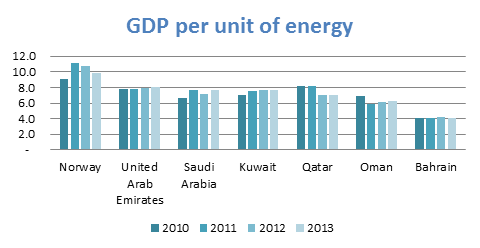
Norway is more productive in its energy consumption. A pssible explanation for the same is that of their total energy consumption, 60% are fossil fuels against almost 100% in GCC countries.
Saudi Arabia
Saudi Arabia’s population has grown from 4 million in 1960 to almost 30 million in 2014. It is the main electricity producer and consumer in the Gulf States, with 272 TWh gross productions in 2012 – 150 TWh from oil and 121 TWh from gas.
There is large demand for desalination, currently fueled by oil and gas. Energy use for electricity and heat production including desalination in 2011 was 28,783 PJ. It consumes over one-quarter of its oil production, and while energy demand is projected to increase substantially, oil production is not and by 2030 a large proportion will be consumed domestically, much of it for electricity generation.
The country has had plans to diversify its energy sources to solar and nuclear power. It plans to construct 16 nuclear power reactors over the next 20 years at a cost of more than $80 billion, with the first reactor on line in 2022. It projects 17 GWe of nuclear capacity by 2040 to provide 15% of the power then, along with over 40 GWe of solar capacity.
Saudi Arabia currently accounts for 42 percent of the $125.3 billion worth of projects underway in conventional power generation, transmission, and distribution across the Gulf.
The government is seeking active participation from the private sector through the construction and financing of public-private partnerships. Under the supervision of the SEC (Saudi Electric Company), the independent power project (IPP) program is designed to provide long-term, build-own-operate schemes that are set to eventually provide 30 percent of the country’s electricity supply.
Recent IPP projects include the Rabigh 2 IPP (R2IPP), the Riyadh PP-11, and the Qurayyah IPP Combined-Cycle Power Plant. The R2IPP will be completed in June 2017 with a generating capacity of 2,100 MW.
The economic and social rationale for the energy transition in the GCC has never been stronger. By maintaining their leadership in the energy sector and embracing their region’s abundance of renewable energy resources, GCC countries can ensure their own long-term economic and social prosperity through a clean energy future.