

 It is hard to argue that the environment, social, and governance (ESG) factors are not material in investments. However, how do you actually integrate ESG considerations into investment decision making in practice?
The importance of responsible investing (RI) has increased substantially in recent years. In 2017, CFA Institute conducts an online survey among its members. CFA Institute members mostly are portfolio managers and research analysts. The purpose is to better understand the perceptions of CFA Institute membership concerning ESG issues and ESG data, as well as, how members use such information in their investing processes in addition to understanding trends in ESG analysis and point to what best practices are being established.
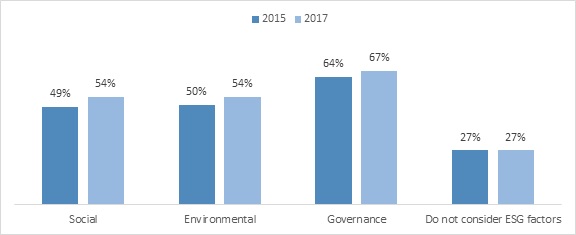
Who considers ESG in investment decisions in 2017?

The key aspect of RI is the integration of ESG factors in the investment process. What is meant by this is that, in addition to reviewing the financial data of a company, you should also include an analysis of intangible factors that relate to how a company deals with its environment, how it addresses its labor force and supply chain, and how aligned the management team is with outside shareholders. These ESG factors can have an important impact on investment performance, and hence not including a proper analysis of these ESG factors actually results in an incomplete assessment of the potential investment and therefore could even lead to incorrect investment decisions being made.
One of the reasons that responsible investing took years to be accepted is the misperception that investing in a responsible way would actually reduce the investable universe and therefore would have a negative impact on investment performance, reducing return or increasing risk. RI was seen as being too «green» and implementing it would hurt performance. Many studies have been done in this field in recent years, which prove the opposite. For example, study, published by Alex Edmans shows that the higher the employee satisfaction, the better the stock returns. Another study by Derwall, Bauer, Guenster, and Koedijk, shows that the best environmental responsible companies outperform the least environmentally responsible firms.
To implement ESG factors in the decision-making process you could use data from third-party vendors. For examples, Sustainalytics and MSCI ESG Rating which could provide you a good and efficient view on how a company scores on a variety of ESG factors, including governance, related party transactions, alignment of performance targets, environmental impact, human rights issues, fraud, and/or tax evasion to name just a few. This data gives the analyst a good starting point to further review the company’s situation, and it helps the analyst to form a clear opinion, an opinion he should incorporate in his both valuation and recommendation.
When integrating ESG factors into an investment analysis should focus on materiality, i.e., factors that are likely to have a material impact on the (longer-term) sustainability of a company’s business model and its share price performance. Examples include safety standards, shareholder engagement, and environmental impact in the mining industry; labor issues and food safety in the consumer sector; product liability and bribery in the healthcare sector; and governance and alignment between management and shareholders in general.
Growth in the use of ESG factors: 2015 to 2017 comparison
The goal of investing in a responsible way is to look for sustainable business models, models that result in having a competitive edge and enabling the company to achieve better returns. Longer-term this should lead to superior investment performance from a risk/reward standpoint. Furthermore, integrating ESG factors should also be seen as simply being a more complete approach to investing. This gradual realization is now leading to an increasing focus on the analysis of ESG factors in the overall investment process.
Increased importance of responsible investing and ESG integration brings clear opportunities to the asset managers and investment professionals who will be able to embrace this trend.