

With increasing population, development and consumption patterns, world resources are more strained than ever before. Ecological assets are at the core of e very nation’s long-term wealth and their conservation, one of the prime objectives of nations across the world. It is therefore important to understand how it is measured.
Global Footprint Network, a non-profit organization, measures the supply of and demand of nature. On the supply side bio capacity represents the planet’s biologically productive land areas including forests, pastures, cropland and fisheries. These areas, especially if left unharvested, can also absorb much of the waste we generate, especially our carbon emissions.
Bio capacity is then compared with humanity’s demand on nature: our Ecological Footprint. The Ecological Footprint represents the productive area required to provide the renewable resources humanity is using and to absorb its waste.
The productive area currently occupied by human infrastructure is also included in this calculation, since built-up land is not available for resource regeneration. These two concepts were developed by the Global Footprint Network and are quantified as global hectares (gha). If the ecological footprint of a human population exceeds the bio capacity of its environment, the situation is unsustainable.

GCC countries record the highest footprint figures in the world of which UAE residents have one of the world’s largest ecological footprints.
Carbon Emissions
Among GCC, carbon footprint portion accounts for almost half of the total Ecological Footprint. The environmental impact of the largely inefficient fossil-fuel burning on the quality of air has been significant.
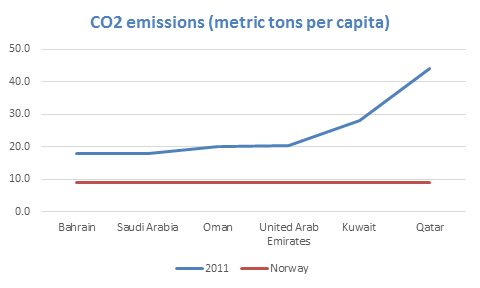
There is a huge gap between carbon emissions of Norway and GCC countries with Qatar performing very poorly. Norway has been used as the base as it has one of the lowest emissions under high income countries.
A study in Qatar found that construction and industrialization are having damaging effects on fragile coastal habitats and marine life, with several fish species feared to be depleted.
Marine fisheries account for 57 percent of all available bio capacity in the GCC countries. Pollution, habitat destruction, climate change, and overfishing are threatening the long-term productivity of marine resources there. In a sign of deteriorating fisheries, some GCC States, such as Kuwait, have already turned to aquaculture to maintain fish supplies, while others, such as Qatar, are creating a local aquaculture industry to meet future demand. The extensive use of chemicals, processed feed, and accelerated fattening techniques in aquaculture bring their own set of serious environmental and health consequences.
Population growth reduces bio capacity per person. The situation in member countries of the GCC offers a distinct case study of the impacts of population and consumption on the ecological footprint of these countries, because of the large influx of labor migration over the past four decades. Rapid population growth in GCC nations due to rapid influx of expatriate workers, accelerates resource use and waste generation and quickens the pace of environmental degradation.
GCC governments have taken some serious decisions and invested in higher education and research to develop its youth. As the number of national citizens enrolled in these universities increases over time, the path to a knowledge economy will become more plausible, leading to a more balanced workforce.
Saudi Arabia
Increasing water shortage, cereal production and rising CO2 levels are its biggest challenges today. On November 10th 2015, Saudi Arabia submitted its Intended Nationally Determined Contribution (INDC), seeking to reduce its emissions annually by up to a total 130 MtCO2e in 2030 from 490 MtCO2e annual emissions in 2014 through measures that have co-benefits in pursuing economic diversification from oil while contributing to greenhouse gas abatement and adaptation to climate change.
Achievement of this goal is not conditional on international financial support, but is contingent on the continuation of economic growth, and a robust contribution from oil export revenues to the national economy. Saudi Arabia would adjust its INDC between 2016 and 2020 if the consequences of the Paris agreement would create an abnormal burden on its economy.
GCC countries are focusing on reducing their global footprint by meeting their water needs more efficiently. Energy efficient technology in GCC can save as much as 17 percent of electricity consumed for desalination in Saudi Arabia, and 16 percent in the UAE in 2025. With more than $300 billion being invested in GCC water and desalination projects between 2012 and 2022, this energy-saving potential could soon become a reality. Global Clean Water Alliance was launched by Abu Dhabi’s renewable energy company Masdar at Paris-based COP21 aimed at achieving a sustainable water future The Alliance, an international coalition of more than 80 members, is aiming to reduce carbon emissions from desalination by up to 270 metric tons annually before 2040.