


GCC governments have placed a large importance on providing access to education to all GCC citizens, and worked on the development of the education sector to keep pace with the evolving and rapidly developing world and the changes in the various fields of knowledge.
The GCC governments worked on developing this important sector by continually reviewing educational programs and paid close attention to the quality of education by committing resources in an effort to further develop this crucial sector. According to the figures published by GCC-STAT for the educational sector in the year (2011/2012) the total number of schools in the Gulf Cooperation Council reached 34,529 with a total of 9,210,443 students, and 862,626 teachers with an average of 10.68 students per teacher.

With over 90% of its overall and both male and female population literate, GCC scores very well in HDI against other countries.
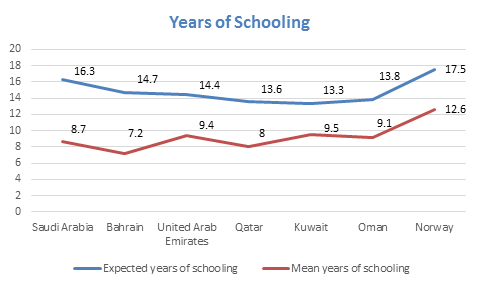
A closer look at the mean years of schooling indicates that the expectation is to complete graduation, whereas students usually quit school after 8-9 years. The benchmark is much higher in Norway but the gap also exists.
Saudi Arabia
Education policy in the Kingdom of Saudi Arabia is concerned with the education system as a civilizational demand which it tries to meet by the continuous development of educational systems and regulations to keep pace with the rapid developments in human activity. Education policy in the Kingdom of Saudi Arabia believes in the principle, based on religious and social constants and engagement with international agreements and declarations, including the Dakar Declaration (2000), of equality of opportunity for all citizens. It has low years of schooling coupled with high youth unemployment rates.
One of the ways to improve the current situation identified by the Ministry of Education is to increase the accountability of teachers. In 2011, they announced a new strategy to put 80% of the weight of evaluating teachers’ performance on their students’ performance on standardized tests. The results from this process of evaluating teachers will determine who deserves incentives for their outstanding performance.
‘The National Forum on Education for All’ aims to provide basic education for all by 2015 at the latest. Also within the concept of “Education for All”, the Ministry has drawn up a pioneering plan entitled, “Town and Village without Illiteracy” which aims to declare towns and governorates free from alphabetic illiteracy.
The secondary level of adult women’s education began in 2001 with eight schools, eight classes and 158 students; at the end of 2006, there were 43 schools, 127 classes and 3,043 students. Informal programs include mobile adult education and literacy centers, given that geography makes it difficult to establish permanent centers.
The goal is to eradicate alphabetic illiteracy among female nationals and raise their religious, health and social consciousness. In 2002, there were 29 centers and 1,531 beneficiaries rising, at the end of 2006, to 359 centers and 10,782 beneficiaries. The summer campaigns conducted by the Ministry of Education to disseminate knowledge and information are one activity which has borne fruit in this area.
Efforts to raise levels of education and transform itself into a knowledge economy are at the forefront of GCC countries.