




Capturing a variable like Welfare can be very complex. A number of factors contribute to the happiness and overall well-being of a population. Polls conducted by Gallup Inc. try and measure perceived welfare i.e. how people across the world actually rate their satisfaction of the provided welfare.
The Gallup World poll conducted by Gallup Inc. gathers data by directly asking over hundred questions from almost 99% of world’s adult population. Certain factors have been identified as important and most contributing to the overall welfare of a population. These are captured in the Gallup Macroeconomic Path.
Gallup Macro-Economic Path


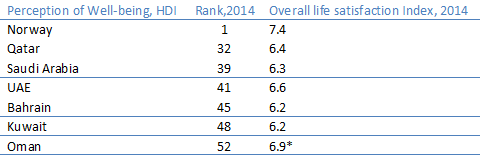
UNDP taking help from this data develops two indices– Perception of well-being and the World Happiness Report. According to HDR 2015, indicators of perceived individual welfare are quality of education, health, standard of living, feeling of safety and freedom of choice and the GCC countries rank as follows:

Another interesting reports developed using Gallup data is the World Happiness Report which measures happiness, considered as a very good indicator of overall welfare of a country.

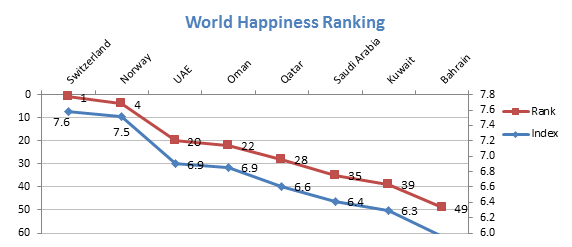
Of the 159 countries, GCC countries rank well on the happiness index. While all of them perform well on determinants like GDP, life expectancy and social support, factors like freedom of choices and perception of corruption bring the ranking down.
GCC countries have had a generous welfare system in place for more than four decades now. Welfare is broadly the level of prosperity and standard of living of either an individual or a group of persons.
With the world’s largest oil resources, there arose unrealistically high economic expectations. As the world moved to alternate sources of energy after the two oil shocks, the economies tried to reduce the expectations but it has been difficult ever since due to the high benchmark and expectations of the citizens.
High levels of subsidies are extended to citizens. It has helped raised the standard of living of citizens but discouraged acquisition of skill sets. (Long and Koch, 1997).
Given that, the GCC countries rank high on the HDI; Human Development Index – a composite statistic of life expectancy, education, and income per capita indicators.

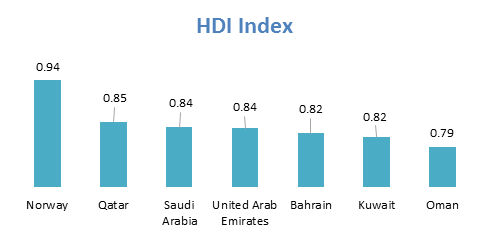
The major important components of HDI are built around healthcare and education.