


Unemployment is a huge concern for any nation. Among the GCC countries, the average unemployment rate is higher than most countries falling in the same GDP bracket.

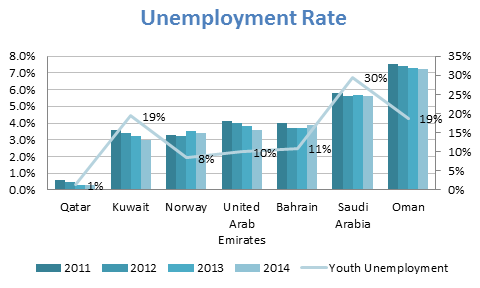
It is interesting to note that despite the highest foreign population stock, both unemployment and youth unemployment rates are lower in UAE than other GCC countries with comparatively lower foreign population. Also, where economies have diversified more from oil, unemployment rates are lower.
With more than half of GCC population is below the age of 25, it is important to note that with high immigrant population, fewer skilled jobs and unwillingness to take up meagre jobs, the local population has overall fewer employment options taking youth employment to much higher levels.
Saudi Arabia
Both unemployment and youth unemployment are starkly high in Saudi Arabia. Saudi Arabia’s government plans a new set of labor quotas and incentives to reduce unemployment as it tries to wean its economy off oil exports. Under a government program called Nitaquat (“Categories”), launched in 2011, companies are already encouraged Saudization – to hire Saudis rather than cheaper foreign workers.
Firms employing high ratios of Saudis receive preferential treatment from the labor ministry in processing work permits. The scheme has had only limited success. The official unemployment rate rose to 11.6 percent in 2015 and net employment of Saudis rose by only 49,000 in 2015, its slowest increase since records began in 1999, as the government cut spending because of low oil prices.
More than 1 million Saudi Arabians are now receiving unemployment benefit. The “Hafiz” program pays unemployed Saudis 2,000 riyals ($533) a month for up to one year. The numbers of beneficiaries under the program have been rising at a rapid rate. Around 90 percent of Saudis in work are employed by the government, while 90 percent of jobs in private companies are filled by around 8 million foreigners.
Expatriates tend to fill higher-paying technical roles for which many Saudis lack the experience, and very low-paying jobs that many Saudis see as menial.
The demand for expatriate workers in GCC countries was a necessity in the early period of state and institutional building, especially with the advent of oil, when only low levels of education and skill were available locally.
It can also be argued that a large expatriate workforce was needed to harness oil in a more efficient manner and to secure proper development, with the required infrastructure.
Given that the GCC countries have already achieved comparatively high standards of living by undertaking infrastructure investments to support social and economic development, even achieving a higher per capita GDP in 2008 than the European Union countries as a group, it is now imperative to re-evaluate current economic development structures and to accord a higher priority to social and environmental goals.
GCC countries are taking serious steps towards economic diversification and transitioning to a knowledge economy. This requires preconditions such as the creation of a robust industrial base, a strong higher educational system, and a sound research and development infrastructure.
However, the most critical prerequisite is a demonstrated willingness on the part of national citizens to embrace opportunities in all these spheres. Actions by all GCC governments to seriously invest in higher education and research are commended. As the number of national citizens enrolled in these universities increases over time, the path to a knowledge economy will become more plausible, leading to a more balanced workforce.