


Infrastructure is one of the most important pillars of development. One of the major areas of diversification for GCC countries has been infrastructure. The construction market in GCC has been experiencing healthy growth in recent years, which is driving the demand for cement in the region. The cement market in GCC is dominated by well-established pure players.
Some of the major players in this market are Gulf Cement, Kuwait Cement Company, Lafarge, Oman Cement Company, Qatar National Cement, and Saudi Cement Company.

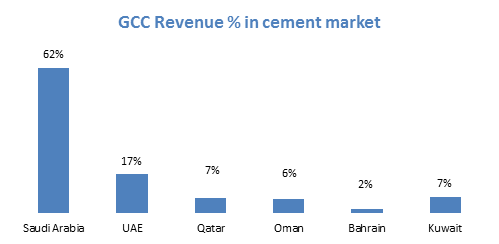
Saudi Arabia is the largest region for the cement market in GCC. Almost two-thirds of the revenue from GCC comes from here.
Transportation infrastructure is at the center of Saudi Arabia’s plans to diversify its oil-dependent economy into a connected modern economy. The government has initiated a number of large-scale construction works for the coming years valued at $800 billion (£523 billion).
The boom of Saudi Arabia’s construction sector – its second largest industry behind hydrocarbons – has seen the rapid expansion of the country’s infrastructure over the past two decades. Today, the industry contributes approximately 8 per cent of Saudi Arabia’s total GDP.
As part of the country’s economic goals for diversification and job creation, the major emphasis of upcoming projects is to achieve more balanced development. Together, education and healthcare remain a priority for the government, accounting for 37 per cent of construction sector spending, with a total of $85 billion set to fund more than 500 new schools and colleges and 19 new hospitals over the next few years.
Meanwhile, $43.8 billion has been allocated for transport, telecommunications, water, agriculture and other related infrastructure, with transport development in particular seen as essential to enhancing construction industry growth. Saudi Arabia has several railway projects in the pipeline, for instance, which aim to support intra-regional trade and increase the country’s export capacity.
Alongside this, the country also began work on its long awaited first metro rail network in the capital Riyadh last year, which is set to be the world’s largest public transport system.
Other mega projects – designed to promote development across the country – are the construction of six economic cities, including the 168 km, $75 billion King Abdullah Economic City in Rabigh (set for completion in 2029).
The Kingdom Tower in Jeddah, meanwhile, will be a true symbol of the strength of the Saudi construction industry when it is unveiled in 2019; becoming the world’s tallest building.
Housing
One of the major factors driving this investment is the rising population in the country that has created a strong political pressure to meet the growing demand for housing infrastructure.
One of industry’s significant challenges is the massive housing shortage. In a bid to meet market shortfalls, Saudi Arabia is accelerating the delivery of new homes, while other initiatives, such as promoting real estate activity on unused land, are also being deliberated.
To meet the demand, the government has planned considerable investments in the affordable housing sector. In 2014, the government launched a housing scheme, which was aimed to build 500,000 housing units in Saudi Arabia, with an estimated investment of over USD 50 billion.
In addition, it is estimated that an investment of over USD 55 billion will be made in transport, power, and energy projects, social infrastructure, and other civil works in the coming years. Such investments are therefore expected to increase the demand for building materials, including cement, in Saudi Arabia.


Port infrastructure quality is best in Singapore in the world. Among the GCC, port infrastructure is strongest in UAE. In Saudi Arabia, the quality of port infrastructure has been falling but is bound to go up with the renewed focus of the government.
King Abdullah Port (KAP), the country’s newest port on the west coast, is at the heart of one of the kingdom’s most aggressive economic diversification experiments, a bespoke port and free zone development near Rabigh, north of Jeddah.
Located within King Abdullah Economic City, the port is the center piece of this nascent economic zone that has already lured some of the world’s biggest companies, such as Mars, Pfizer and Danone. The port already has a container capacity of 3m 20ft equivalent units (teu), which is expected to rise to 4m teu in 2017 as the surrounding city grows from a population of 3,000 to 50,000 by the end of the decade.
New ports are also planned at the south western city of Jizan, which will focus on exporting refined oil products, and at Al-Lith — to handle general cargo diverted from Jeddah Islamic Port. Linking the commercial west with the oil-rich east is another major government project leading the diversification drive.
The Saudi Land Bridge, connecting western Rabigh and Jeddah to eastern Dammam and Jubail by rail, could further revolutionize cargo transport in the Gulf. Scheduled for completion in 2020, the $7bn project includes the refurbishment and laying of new track.
The regional infrastructure market is expected to see tremendously increased activity over the coming years as GCC governments look to increase budgetary allocations in order to boost job creation, economic growth and diversification, despite the slump in oil prices.